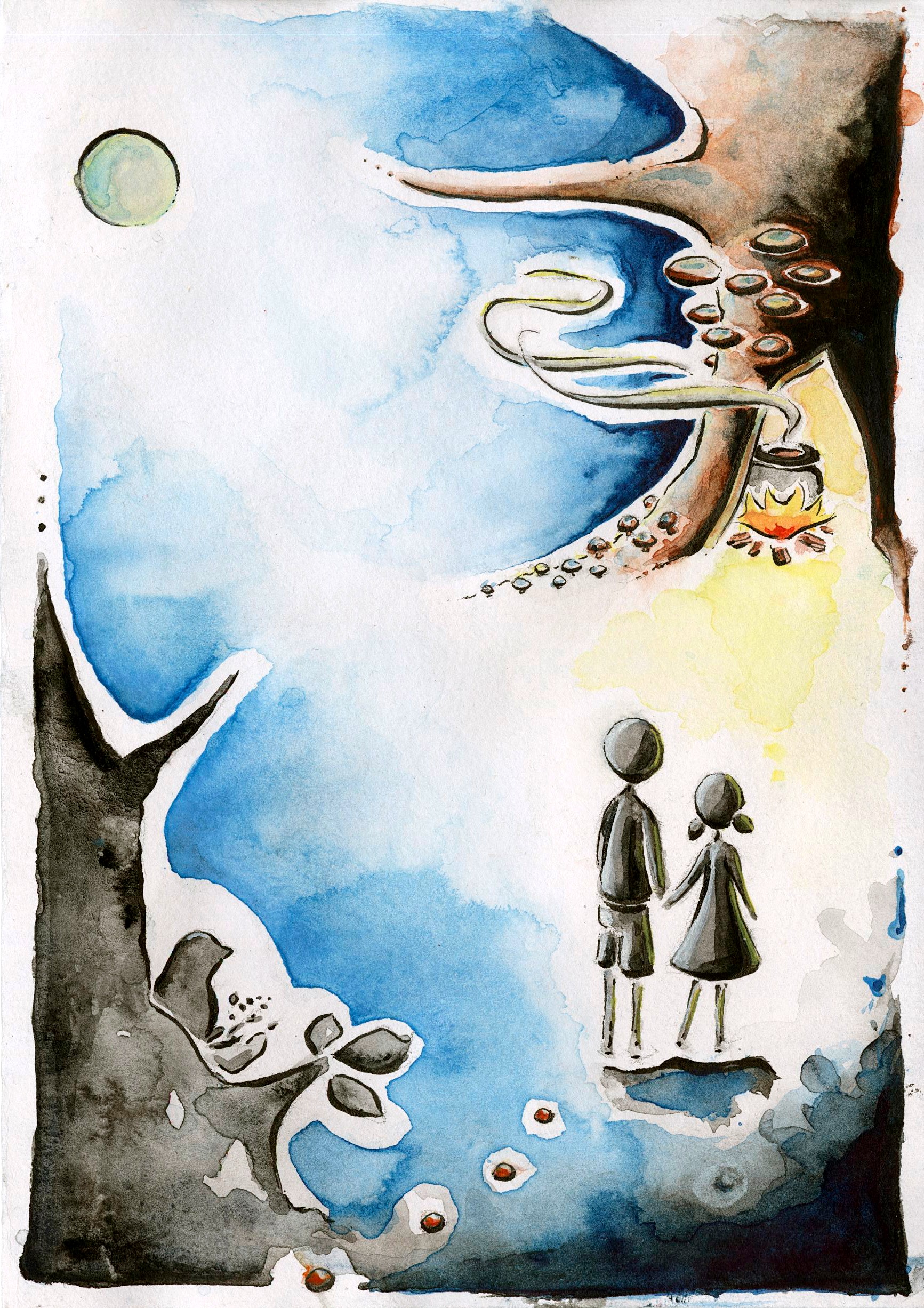
That’s the title, actually. This Is Not Hansel & Gretel.
So… by way of explanation for that “Is Not” part: basically, you think you know the story, but your knowledge is probably as woefully incomplete as mine was, before I began.
In February of 2022, I was somewhere around Draft 5 of Alexander Klaus, the One-Legged Shoemaker Man, which I would bring to Edinburgh Fringe in 2023 — and then, in December of 2024, to New York’s 59E59 Theaters. But Alexander’s story was all but done at this point, and I was frankly a little lost, about what my next piece might be.
On a whim, I went one night to see Lili Taylor in Suzanne Bocanegra’s piece Honor, about the 1532 Honor Tapestry at the Metropolitan Museum of Art. Somewhere in the middle of the piece, she spoke the following words about famine, in medieval Europe:
“Fifteen to twenty percent of the population were always hungry. And in wartime, that could go up to sixty percent. That’s why there were so many fairy tales about eating people. It happened.”
The next slide showed a pair of Hansel & Gretel dolls.
Now and then we’re lucky, and we get a bolt of creative lightning. That’s what this was — and honestly, it eradicated my memory of the rest of the lecture. Entirely. But I had what I needed: I knew what story I would tackle next.
With a little historical research, I found the Great Famine of 1315-1317, when it rained in Europe for two years. Crops failed. People died. There was cannibalism, in Europe. And that is where we get the story of Hansel & Gretel.
. . . . . . . . . . . . . . .
This is the third show I’ve done with my director Jenny Mercein, who somehow keeps showing me surprising things about my own writing. Which is, of course, why there are directors. I’m very happy to be working with Jenny, who helped me get to a real theater, with real seats, and real people sitting in the dark, to hear my stuff. And then, drinks in the bar after.
The artwork is by my friend Tinna Þorvalds Önnudóttir, whom I met at Reykjavik Fringe in 2021, when I premiered my piece on the Icelandic legend, Grýla – Not for Children. Tinna and I have done a couple of things together — we have a children’s book! — and I’m thrilled to have this as my flyer for Fringe, to give out on the Royal Mile in Edinburgh.
I’ll see you at Banshee Labyrinth, where the show is hosted as part of the PBH Free Fringe. Come say hello afterward!
(Oh and by the way — for slightly more up-to-the-minute news, you can follow me on Instagram @christianHegeStoryteller.)

